Fabian Krougman 🏴🇳🇱
The case of a Dutch McKenzie Friend who styled himself a barrister, a CILEx Advocate with higher rights of audience, and co-author of a major English legal textbook raises serious questions about how legal titles are policed — and who gets to call themselves a lawyer.
The Krougman Controversy
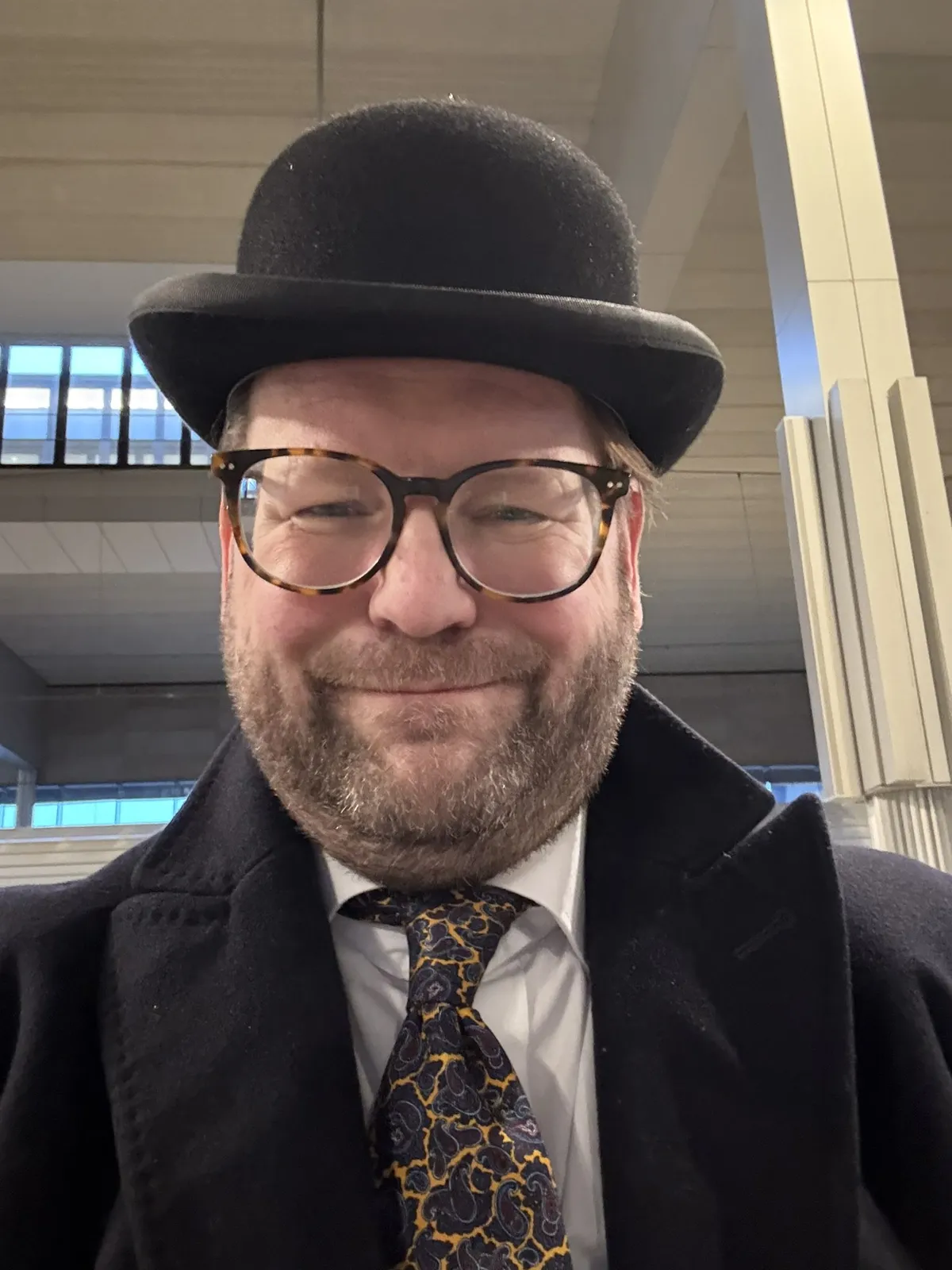
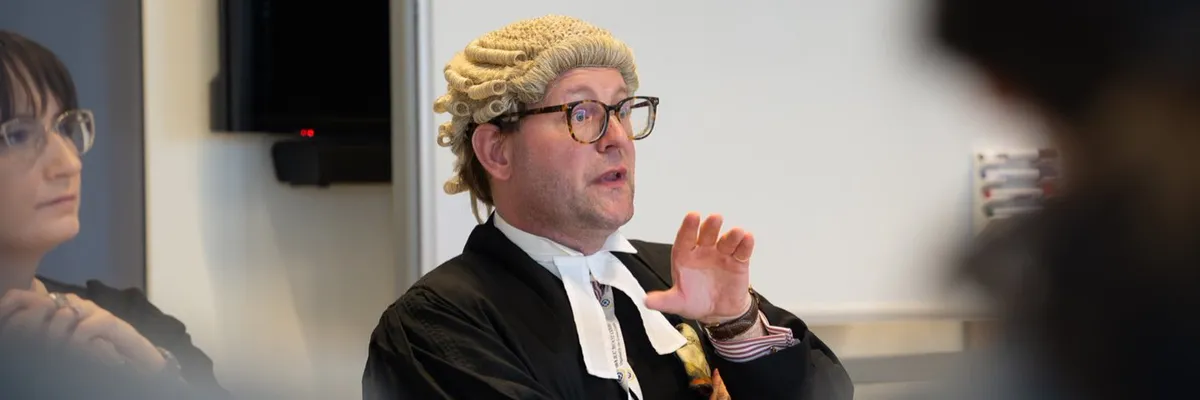
Fabian Krougman, based in Oudenbosch in the Netherlands, has for years presented himself with an impressive array of legal credentials spanning both English and Dutch law. His biography on the Bloomsbury Professional website described him as a "CILEx Advocate (with higher rights of audience)" whose practice specialised in private prosecutions and international criminal defence. His own website identified him as a "Legal Executive (CILEx)" and advocate. He participated in the 2022 South Eastern Circuit Bar Mess Foundation Advanced International Advocacy Course at Keble College, Oxford, an event aimed at qualified practitioners. He has been photographed wearing a barrister's wig and gown.
The difficulty is that much of this appears to be false or materially misleading.
In January 2026, investigative legal publication RollOnFriday reported that Krougman confirmed he was not currently a CILEx advocate, and that his claim to hold higher rights of audience was made in anticipation of passing exams he had in fact failed (and that he was, in all likelihood, not eligible to take in the first place). He also acknowledged that he did not carry out private prosecutions. When asked whether he had a law degree, Krougman told RollOnFriday: "My CV speaks for itself“ - which clearly translates as “no”.
The Barrister Question
The title dispute extends back at least a decade. Correspondence that Krougman himself posted on X (formerly Twitter) shows that in 2016 he wrote to the Bar Standards Board signing himself "Fabian Krougman Esq — Barrister at Law", asking whether he could use that title while applying under the Bar Transfer Test route for qualified foreign lawyers. The BSB's response was unambiguous: "You cannot call yourself a Barrister." Krougman replied disputing this on the basis of something he believed he had read in an unspecified "reglementary document" (sic). When the correspondence shifted to a new subject heading — "Holding Out as a Barrister" — Krougman wrote: "There is no basis for any criminal charges because I did not hold myself out as barrister in England and had the genuine belief I was entitled to do so."
This exchange is legally significant. Holding out as a barrister in England and Wales is a criminal offence under section 4 of the Legal Services Act 2007, which prohibits a person from wilfully pretending to be entitled to carry out reserved legal activities. Whether or not Krougman crossed that threshold is a matter for regulators to determine; what the exchange does demonstrate is that he had been expressly told by the BSB that he could not use the title, yet continued to use it in various contexts. Archived web pages from 2017 show his Netherlands practice trading as "Krougman Chambers" with the tagline "Barrister + Juristen".
The Bar Transfer Test route he claimed to be pursuing is available only to qualified foreign lawyers — specifically, those who are fully admitted to a Bar in another jurisdiction. Comments on the RollOnFriday article from practitioners with knowledge of Dutch law noted that Krougman is not, and was not, an advocaat (the Dutch equivalent of a barrister or solicitor) but rather a gerechtelijk gemachtigde — an unqualified legal representative permitted to act in lower-level Dutch courts — and one who had, moreover, been suspended from even that role.
A Pattern in the Netherlands
The Dutch record is troubling on its own terms. According to a Dutch legal commentary site (SIN-NL, published in 2018), the Gerechtshof Den Bosch confirmed the suspension of Krougman as a gemachtigde before the courts of Bergen op Zoom and Breda on two separate occasions in 2003, on the ground of unlawfully using the title Meester in de Rechten (the Dutch academic title for law graduates, abbreviated Mr.), which he was not entitled to use as he had not completed a law degree. He was also reported to have been suspended from appearing before the court in Bergen op Zoom for five years from 2013. The SIN-NL source further noted that a Dutch insolvency register records a bankruptcy relating to Rechtspraktijk Krougman.
What is independently verifiable from the RollOnFriday reporting is that the Netherlands court archive of published decisions shows that a number of his recorded cases were dismissed by judges as "filed entirely unnecessarily", "initiated prematurely", "manifestly unfounded", and "groundless".
The Bloomsbury Textbook
The immediate catalyst for public attention was the planned publication by Bloomsbury Professional of a textbook entitled The Law and Practice of Private Prosecutions, co-authored by Krougman and Chloe Ashley, a qualified criminal barrister. When questions were raised by RollOnFriday in late January 2026 about Krougman's credentials, the book was first replaced by an error page and then removed entirely from Bloomsbury's website. Bloomsbury did not respond to requests for comment.
Ashley's credentials are not in question. She is a practising criminal barrister. The co-authorship arrangement appears to have arisen from the pair having met at the 2022 South Eastern Circuit advocacy course at Keble. A commenter on the RollOnFriday article noted that the course itself accepts international participants, but questioned how Krougman came to be accepted given that he was not a qualified advocate in his home jurisdiction.
What the Law Says — and Does Not Say
The Krougman case exposes a structural gap in English legal title regulation that the Reynolds affair (concerning Business Secretary Jonathan Reynolds calling himself a solicitor) has also brought into focus. The title "barrister" is legally protected. Section 4 of the Legal Services Act 2007, read alongside the Criminal Justice Act 1967 and earlier Bar legislation, makes it a criminal offence to wilfully hold out as a barrister. The Bar Standards Board has regulatory powers and can refer matters for prosecution.
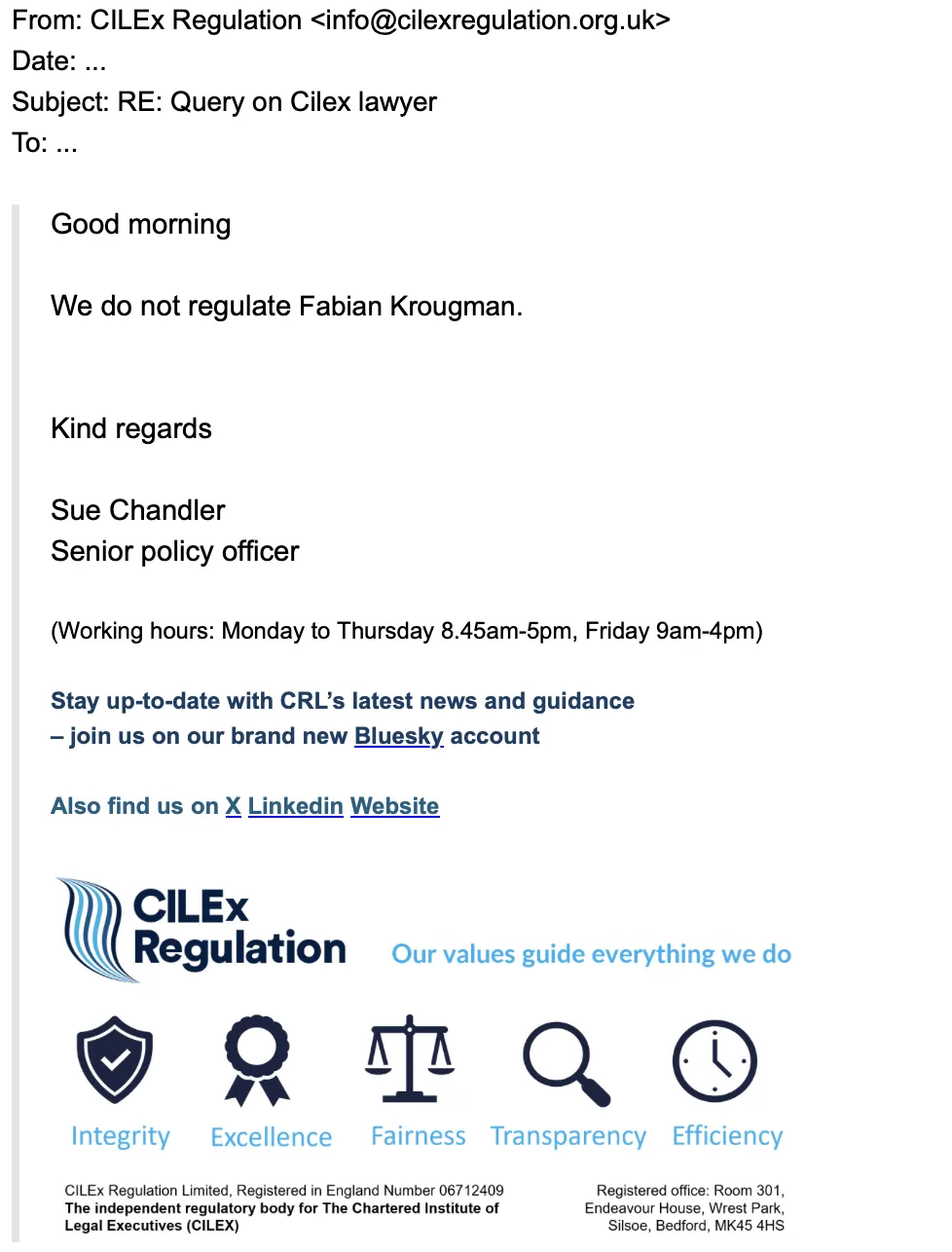
The title "CILEx Advocate" is also regulated: the Chartered Institute of Legal Executives has a defined qualification pathway, and claiming to hold that status when one does not is misleading at minimum and potentially a regulatory or criminal matter depending on context. Higher rights of audience are a reserved legal activity under the Legal Services Act 2007; claiming to hold them when one does not is, again, at least potentially within the scope of that Act.
The title "lawyer", however, remains entirely unregulated in England and Wales. Anyone — qualified or not — may use it. This is the same gap that Scotland has moved to close with the Regulation of Legal Services (Scotland) Act 2025, which makes it a criminal offence to use the title "lawyer" when providing legal services for a fee without authorisation, carrying a fine of up to £2,500.
The Publisher Due Diligence Problem
One aspect of the Krougman case that goes beyond regulatory questions about titles is the role of Bloomsbury Professional. As one of the leading publishers of legal reference works in England and Wales, its willingness to commission and nearly publish a definitive practitioners' text from someone whose credentials, had they been checked, would have raised immediate doubts warrants examination. Bloomsbury's apparent failure to verify Krougman's stated qualifications before listing the book for sale is a due diligence failure with real-world consequences — not only for the integrity of the publication but for the co-author whose professional reputation is now associated with the controversy.
What This Case Illustrates
The Krougman case is unusual in that it involves not just one misrepresented title but a pattern of asserted credentials — barrister, CILEx Advocate, holder of higher rights of audience, specialist in private prosecutions — many of which appear not to have been held at any relevant time. Unlike the Reynolds matter, where no prosecution was brought by the SRA in part on proportionality grounds, no English regulator has yet publicly confirmed an investigation into Krougman. Whether the BSB, CILEx, or any other body will act remains, at the time of writing, unclear.
The case reinforces the argument that legal title regulation in England and Wales is not sufficiently robust. When the gap between what someone claims and what they are entitled to claim can persist for the better part of a decade — across websites, correspondence, textbook contracts, and professional profiles — the deterrent effect of existing legislation is clearly limited. Scotland's approach of criminalising the misuse of the generic term "lawyer" is one legislative response. Enhanced publisher due diligence obligations, or a more accessible public register of all regulated legal professionals across all categories, are another avenue worth consideration.